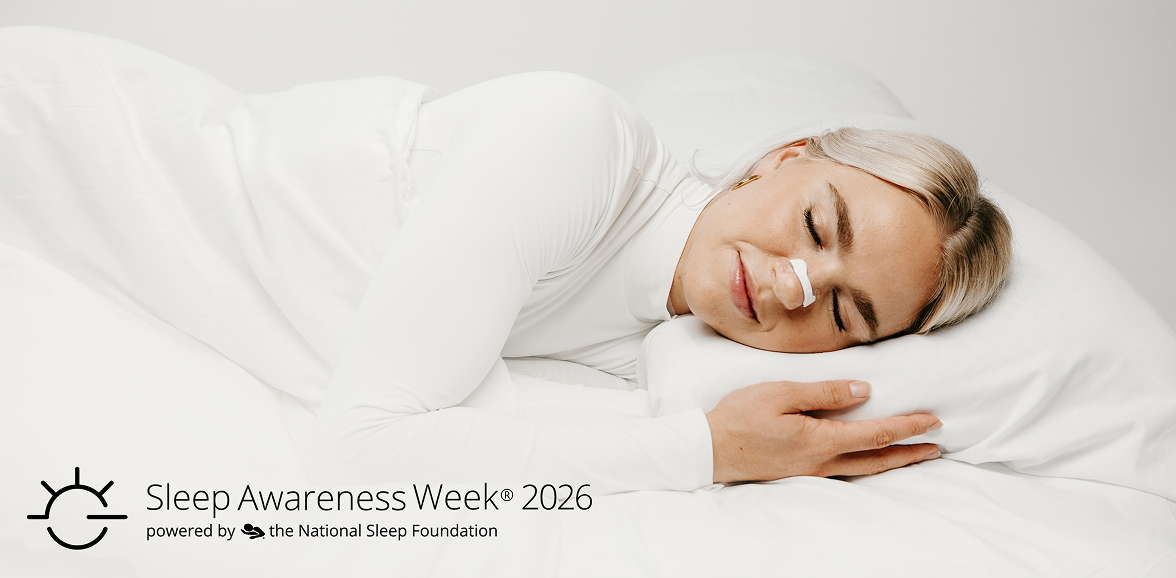
Most of what people know about allergy season is the sneezing, and most allergy treatments are designed around it. But sneezing isn’t what’s disrupting your sleep every night for six weeks. Nasal congestion is. Specifically, what congestion does to the nasal valve: the narrowest part of your nasal passage, and the one that matters most for breathing at night.
Understanding how nasal breathing actually works makes it obvious why allergy season is so disruptive, and why physical nasal support is the piece most people haven’t tried.
How Your Nose Is Designed to Work
Under normal conditions, your nose does far more than move air. It filters out airborne particles, humidifies and warms incoming air before it reaches your lungs, and routes air past olfactory receptors that inform your brain about the environment. Nasal breathing also produces nitric oxide — a molecule that helps dilate blood vessels, improve oxygen delivery, and regulate blood pressure — a benefit that mouth breathing bypasses entirely.
For all of that to happen effectively, air needs to flow freely through a specific structure.
The Nasal Valve: The Narrowest Point That Matters Most

The nasal valve is the narrowest cross-section of the nasal passage. Located just inside the nostril opening, it sits at the junction between the cartilaginous and bony portions of the nose. In most people, it accounts for the majority of nasal airflow resistance even when the nose is completely healthy.
When the nasal valve narrows further from inflammation, tissue swelling, or structural weakness, the resistance to airflow increases dramatically. The relationship isn’t linear: a small reduction in nasal valve width causes a disproportionately large reduction in airflow. Even modest swelling here can make the difference between easy nasal breathing and struggling to breathe through your nose at all.
This is the site where allergy season does its damage at night.
What Pollen Does to Your Nasal Passages
 When pollen contacts the mucous membranes of the nasal passages, it triggers an immune response. The body releases histamine and other inflammatory mediators, which cause vasodilation and tissue swelling in the nasal lining. That swelling is what you feel as congestion, and at the nasal valve, where there’s already limited space, the effects are amplified.
During the day, you’re upright. Gravity helps drain some of the excess fluid. You can open your mouth without consequence if nasal breathing becomes difficult.
At night, both of those compensations disappear. Lying down increases blood flow to the nasal tissue, amplifying swelling. Mouth breathing as a conscious backup isn’t possible when you’re asleep. If the nasal valve closes enough, your body shifts to mouth breathing automatically — and stays there for the rest of the night.
What Happens When You Mouth-Breathe Through the Night

Mouth breathing during sleep isn’t just less efficient — it triggers a cascade that degrades sleep quality in measurable ways:
-
- Dry mouth and throat: the nose humidifies air; the mouth doesn’t, leading to dryness, soreness, and increased snoring
- Increased snoring: mouth breathing changes airflow dynamics in the throat, increasing soft tissue vibration
- Lighter sleep: the disrupted breathing pattern prevents sustained deep sleep stages, fragmenting the sleep cycle
- Morning congestion: a night of mouth breathing often makes nasal congestion feel worse in the morning, not better
Multiplied across six weeks of allergy season, this is a significant cumulative sleep deficit — not one bad night, but an entire season of impaired recovery.
Why Medication Alone Doesn’t Solve It
Antihistamines address the histamine response, reducing sneezing, itching, and some inflammatory activity. They don’t physically reopen a narrowed nasal valve. Many wear off in the middle of the night. Some suppress REM sleep as a side effect, compounding the quality problem they’re meant to solve.
Decongestant sprays temporarily shrink swollen tissue, but with prolonged use, many cause rebound congestion, a rebound effect where nasal passages become more congested when the spray wears off. This creates a cycle of dependency during exactly the period when you need consistent relief most.
Neither approach is a structural solution. They work on the chemistry of inflammation, not the physical state of the nasal airway.
What Physical Nasal Support Does

Physical nasal dilation addresses the airway directly by applying outward pressure at or near the nasal valve to mechanically widen the passage and maintain airflow regardless of how inflamed the surrounding tissue becomes.
The concept is simple: if the nasal valve is the bottleneck, hold it open. Drug-free, no tolerance to build, no rebound effect. The airway either stays open or it doesn’t, and the mechanism should be designed to ensure it does.
How Intake Keeps the Nasal Valve Open

Intake Breathing’s patented two-part magnetic system is built around this principle. Two adhesive Tabs — one per nostril — attach to the sides of the nose at the nasal valve, precisely where restriction occurs. Each Tab contains a steel disc. A reusable magnetic Band then snaps to those discs, gently pulling the nostril walls outward and holding the nasal passage open with structural stability throughout the night.
Because the hold is magnetic rather than spring-based, it doesn’t rely on tension that can collapse under sustained airflow pressure. Because the Tabs only need minimal adhesion — the magnetic connection does the structural work — they stay in place through the warmth and moisture that compromise traditional adhesive strips. Intake was originally developed for athletes, which means it was built to perform under conditions far more demanding than sleep.
The result is an open nasal valve, maintained physically, all night — independent of how inflamed the surrounding tissue becomes.
What the Research Shows

In an independent SleepScore Labs study of 840+ nights, Intake users reported a 41% reduction in perceived nasal congestion. They also woke up feeling well-rested more than twice as often as baseline. 96% of participants said it was easier to breathe through their nose from the very first night.
You can read more about the science behind Intake on the Intake Science page.
A Different Way to Think About Allergy Season
Most allergy treatments are aimed at suppressing the immune response. That’s appropriate for sneezing, itching, and daytime symptoms. But at night, when the nasal valve narrows under inflammation and mouth breathing takes over, the problem is structural, and it needs a structural answer.
Your nose was designed for this. Allergy season closes it. Physical support keeps it open.
The Intake Starter Kit includes four reusable relief bands in every size plus enough Tabs to find your fit from the first night. Drug-free, sweat-resistant, and built to hold all night — every night of allergy season.